Your note and its codes, ready for you and your coder to check.
For primary care, psychiatry, emergency medicine, hospital medicine, telehealth, cardiology, pediatrics, dermatology, and other specialties.
Scribeable writes the note from one recording of the visit. Each sentence drawn from the visit or the chart links back to where it came from, and when the plan needs a detail nobody said, such as a dose, you get a short question about it. It suggests ICD-10 codes, with the matching note text where there is one, and the E/M level from MDM or the time you attest, for you to check, or for your coder on the Practice plan.
14-day Pro trial, up to 150 notes. Then $79/month, unlimited notes.
In the web EHRs our Chrome extension is tuned for, it inserts the note after checking the patient on screen; anywhere else it copies section by section. On the Practice plan with eClinicalWorks, once your practice approves Scribeable in eCW and we set it up, the signed note goes into the chart as a pended Progress Note for you to finish there.

Built by Scott Kohlhepp, DO, a practicing physician
“When the patient walks out, I’m actually done. The note, the codes and the letter are already there.”
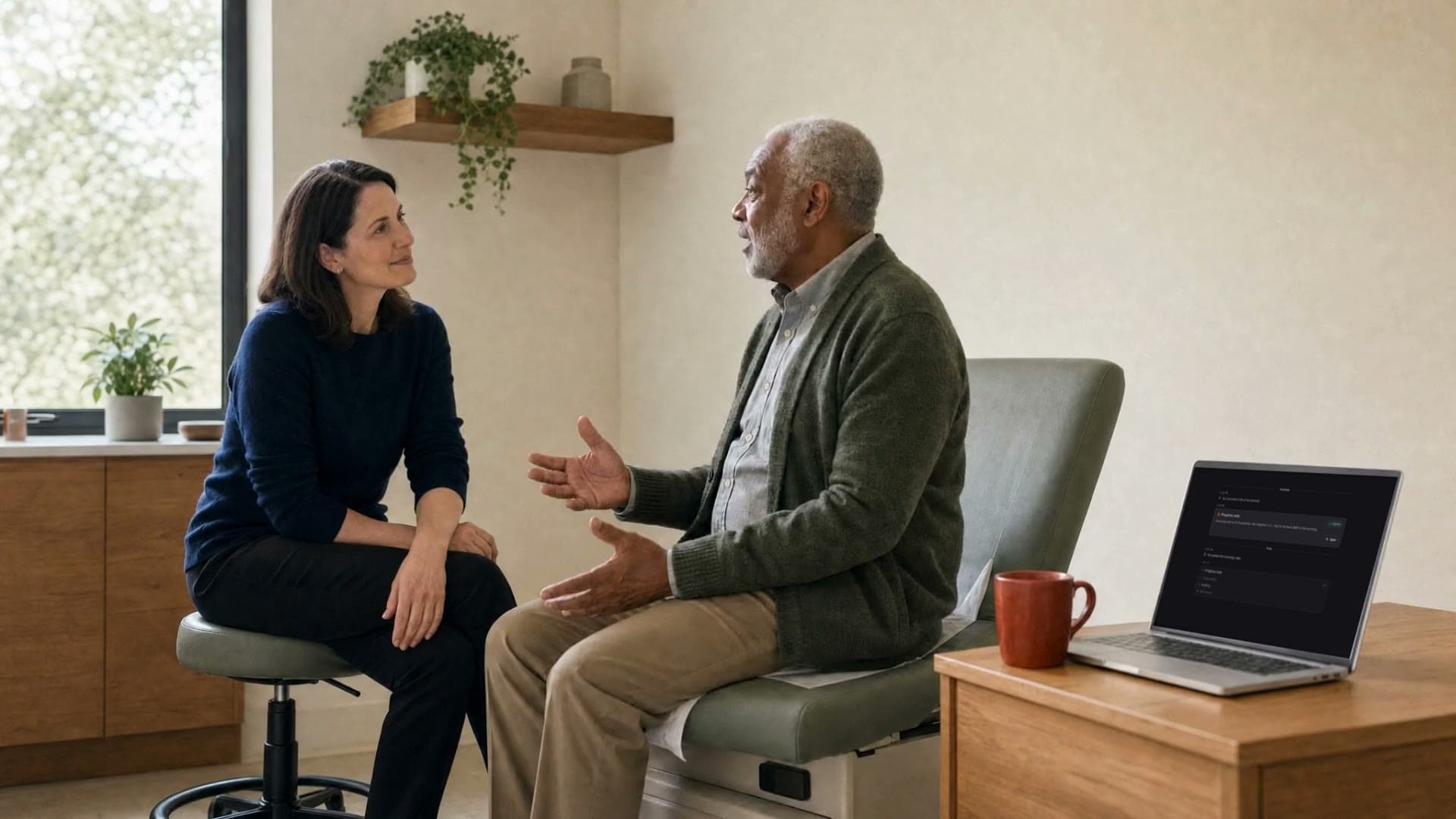
Simulated demo · fictional patient data
For the whole practice: $139 a month per clinician, with a seat for everyone else in the office.
Clinicians
The note, the suggested codes, letters, forms and after-visit summaries, and a list of the orders they discussed.
Coder
A queue of signed notes. ICD-10 codes come with the matching note text where there is one, and the coder can flag a note for clarification.
Front desk
Refill requests, callbacks and questions in one queue, with a standard check on each refill before the clinician approves it. No clinical access.
MAs and nurses
The same patient list. They add outside documents and photos of chart pages, which the next note uses.
Manager
Quality measures from the same notes, the audit log of who opened which record, and a monthly report.
Annual agreement, billed monthly. Try the whole plan free first: 90 days for groups of three or more clinicians, 30 days for one or two. See the Practice plan →
Scribeable in 76 seconds.
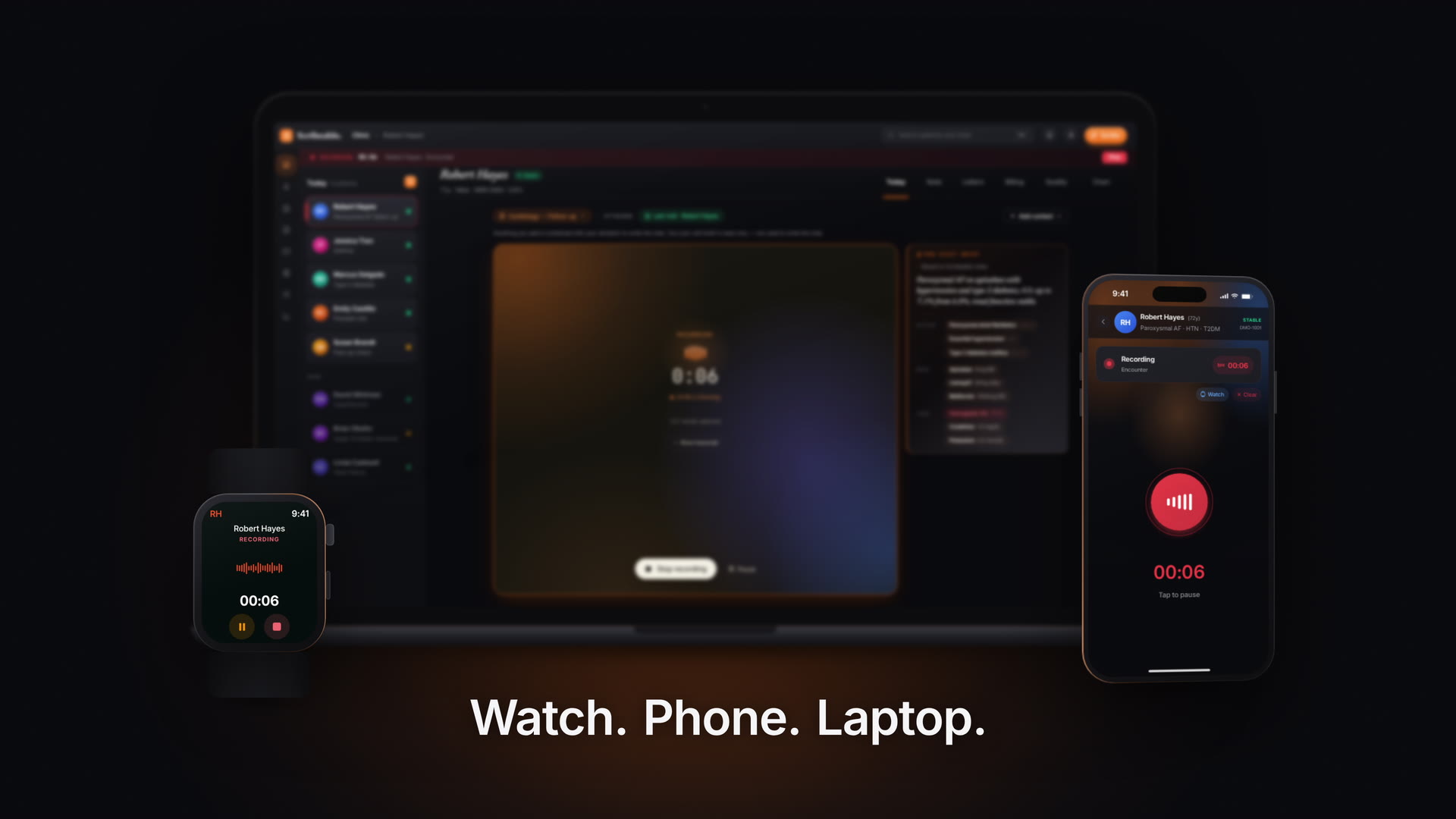
Launch film · fictional patient data
- 236 clinical calculators computed in code
- BAA on every plan
- Never trained on your patient data
Works with
- eClinicalWorks, connected on the Practice plan
- Web EHRs, through the Chrome extension, or by copy
Runs on, under signed BAAs
- Anthropic
- Deepgram
- Google Cloud
- OVHcloud
- Backblaze
Each name is a trademark of its owner. Scribeable is not affiliated with, endorsed by, or certified by any of them. Subprocessor List
Built by a physician. Shaped by the clinicians who use it.
I’m Scott Kohlhepp, a practicing physician. I started building Scribeable after watching the physicians around me spend their evenings charting, and after too many days of finishing my own notes from memory at the end of rounds.
The AI scribes I tried could write a note. I wanted one I could check, so I built one where each sentence links back to where it came from, that asks me when the plan needs a detail nobody said, works out clinical scores in code instead of from memory, and suggests the codes with the matching note text for me to check. Everything on this page exists because I needed it on a real clinic day.
Scribeable bends to your workflow more than most clinicians expect. On Pro, we build your note templates with you before your first visit and adjust the first drafts until they sound like you. When a practice needs something it doesn’t do yet, including a connection to their EHR, we build it with them. If something isn’t working, you can still email me directly at [email protected].

Scott Kohlhepp, DO
Founder, Scribeable · Why I built it
Fitted to your practice
Pro starts with a setup call: your note formats and the features you use, built in before your first visit.
Learns your format
Paste a note you already wrote and it learns your format and wording from it.
Whose account it is
The account is clinician-owned and portable. It moves with you across jobs.
Record. It asks. It drafts and codes.
1 · Record
Press record on the phone or in the browser and talk to the patient the way you always do.
2 · It asks
When the plan needs a detail nobody said, such as a dose, you get a short question about it instead of a guess, and you answer in a click.
Why that matters: in a 2025 peer-reviewed audit of an ambient scribe, reviewers found hallucinated content in 20% of physician-written notes and 31% of AI-generated ones. Palm et al., 2025.
3 · It drafts and codes
The note arrives in your format. Each sentence drawn from the visit or the chart links back to where it came from.
It suggests ICD-10 codes with the matching note text where there is one, and the E/M level from MDM or the time you attest, for you or your coder to check.
What comes out of one visit
The note
In your format, not a template you have to fight. On Pro, your note styles are set up with you before your first visit.
After-visit summary, on Pro
The after-visit summary, drafted from the same visit in patient language. On Pro, including the 14-day Pro trial.
Scores
236 clinical calculators computed in code, not recalled by the model. PHQ-9, eGFR, HEART, and the rest.
Coding
ICD-10 codes with the matching note text where there is one, the E/M level from MDM or attested time, and the HCC V28 categories the note documents. An 8,400-entry crosswalk is built into the note.
Coder queue, on the Practice plan
Your coder gets a queue of signed notes with the suggested codes and the matching note text, and can flag a note for clarification.
Rounding, on Pro
Record one session on the ward and get a separate note for each patient. Two rounding sessions a week on Pro; unlimited during the 14-day trial (fair use applies); not on Lite.
Where the note goes
eClinicalWorks, on the Practice plan
Once your practice approves Scribeable in eCW and we set it up, Scribeable reads the patient’s chart, and the signed note goes into the chart as a pended Progress Note for you to finish there.
Web EHRs
In the web EHRs our Chrome extension is tuned for, it inserts the note after checking the patient on screen.
Anywhere else
It copies the note section by section.
Your EHR, not connected yet
We build new EHR connections together with the practice that pilots them, along with the workflow changes its clinicians ask for. If your EHR isn’t connected yet, your practice can be the one we build it with. Talk to us about a pilot
eClinicalWorks is a trademark of eClinicalWorks, LLC. Scribeable is not affiliated with, endorsed by, or certified by eClinicalWorks.
If you are choosing between a few
The pricing lines below are each vendor’s own published statements, dated on the comparison page; where a vendor does not publish something, the page says so rather than guessing. The points under them are what Scribeable adds.
Scribeable vs Freed AI
Freed AI publishes $39–$119 a month.
Scribeable publishes $39 (Lite) and $79 (Pro) a month, and $139 a month per clinician on the Practice plan.
What Scribeable adds
- A 14-day trial of full Pro, up to 150 notes with no credit card required, against the 7-day trial Freed publishes
- Coding engine (ICD-10, HCC, E&M) included at Pro ($79/month) — Freed lists its coding (E/M, ICD-10, CPT) only on the $104-119/month Premier tier, with no mention of HCC risk adjustment
- 239 clinical calculators in the registry, 236 computed in code, not recalled by the model
Scribeable vs Heidi Health
Heidi publishes a free plan, plus Clinician seats at $110 (Standard) or $299 (Max) per user per month billed annually, or $150 and $409 billed monthly.
Scribeable publishes $39 (Lite) and $79 (Pro) a month, and $139 a month per clinician on the Practice plan.
What Scribeable adds
- HCC crosswalk (8,400+ entries) and MIPS quality measures scored in the note
- 239 clinical calculators in the registry, 236 computed in code, not recalled by the model
- Each sentence drawn from the visit or the chart links back to where it came from, and when the plan needs a detail nobody said, such as a dose, you get a short question about it
Scribeable vs Twofold
Twofold: $49/month annually or $69/month monthly, unlimited notes.
Scribeable publishes $39 (Lite) and $79 (Pro) a month, and $139 a month per clinician on the Practice plan.
What Scribeable adds
- HCC V28 crosswalk (8,400+ entries) and MIPS quality measures scored in the note
- 239 clinical calculators in the registry, 236 computed in code, not recalled by the model
- Each sentence drawn from the visit or the chart links back to where it came from, and when the plan needs a detail nobody said, such as a dose, you get a short question about it
Pricing you can see
Lite
$39/month
Lite is $39 for 100 notes a month. Every note format, the browser extension, and a signed BAA.
No trial on Lite. $39/month is charged at checkout. Cancel any time from Settings > Billing.
The Practice plan is $139 a month per clinician, with a seat for everyone else in the office. Try it free first: 90 days for three or more clinicians, 30 days for one or two. Residents, fellows and students: Pro free for a year, 150 notes a month. Every plan and price →
Questions clinicians actually ask
I already use another scribe. Why would I switch?
If a transcript turned into a note is all you want, most of them are fine. Switch if you want each sentence linked back to where it came from, a short question when the plan needs a detail nobody said, calculators computed in code, and ICD-10 codes and the E/M level suggested in the same pass, with the matching note text where there is one, for you or your coder to check.
Does it work with my EHR?
In the web EHRs our Chrome extension is tuned for, it inserts the note after checking the patient on screen; anywhere else it copies section by section. On the Practice plan with eClinicalWorks, once your practice approves Scribeable in eCW and we set it up, Scribeable reads the chart and the signed note goes into the chart as a pended Progress Note for you to finish there. eClinicalWorks is a trademark of eClinicalWorks, LLC; Scribeable is not affiliated with or certified by eClinicalWorks.
Is it HIPAA-compliant? Do I get a BAA?
Yes. A BAA is included on every plan, including Lite and the 14-day trial, and you accept it when you sign up (if you sign up with Apple, Google or the iPhone app, we ask before you first use it). Every BAA in our own vendor chain is listed publicly on the transparency page. Your data is encrypted in transit and at rest, and we do not use it to train AI models.
How do I know the note is accurate?
Each sentence drawn from the visit or the chart links back to where it came from, so you can open the source and check the line. When the plan needs a detail nobody said, such as a dose, you get a short question instead of a guess. Calculators are computed in code from the documented inputs. You still read and sign it.
What does it cost after the trial?
The 14-day trial is full Pro, capped at 150 notes, and needs no credit card. If you do not subscribe when it ends, nothing is charged and the account goes read-only until you pick Lite at $39 for 100 notes a month or Pro at $79 with unlimited notes. Your notes remain yours to read and export.
I am a resident or a medical student. Is it really free?
Yes. Pro is free for one year, at 150 notes a month, for verified residents, fellows and medical students. Verification happens inside onboarding, and we email you before anything renews.
Run like the systems your notes go into.
A signed BAA on every plan, including the trial, encryption in transit and at rest, and every vendor in our chain listed on the transparency page. The numbers here are read live from the same source as our trust page.
Uptime, 90 days
99.97%
Encryption at rest
AES-256-GCM
Subprocessors, listed publicly
22
- NVIDIA InceptionProgram member
- OVHcloud Startup ProgramMember
- DeepgramStartup Program participant · speech recognition
Try it on tomorrow’s visits.
Record one visit, read the draft, and see whether it sounds like you. If it does not, your templates are set up with you until it does.